

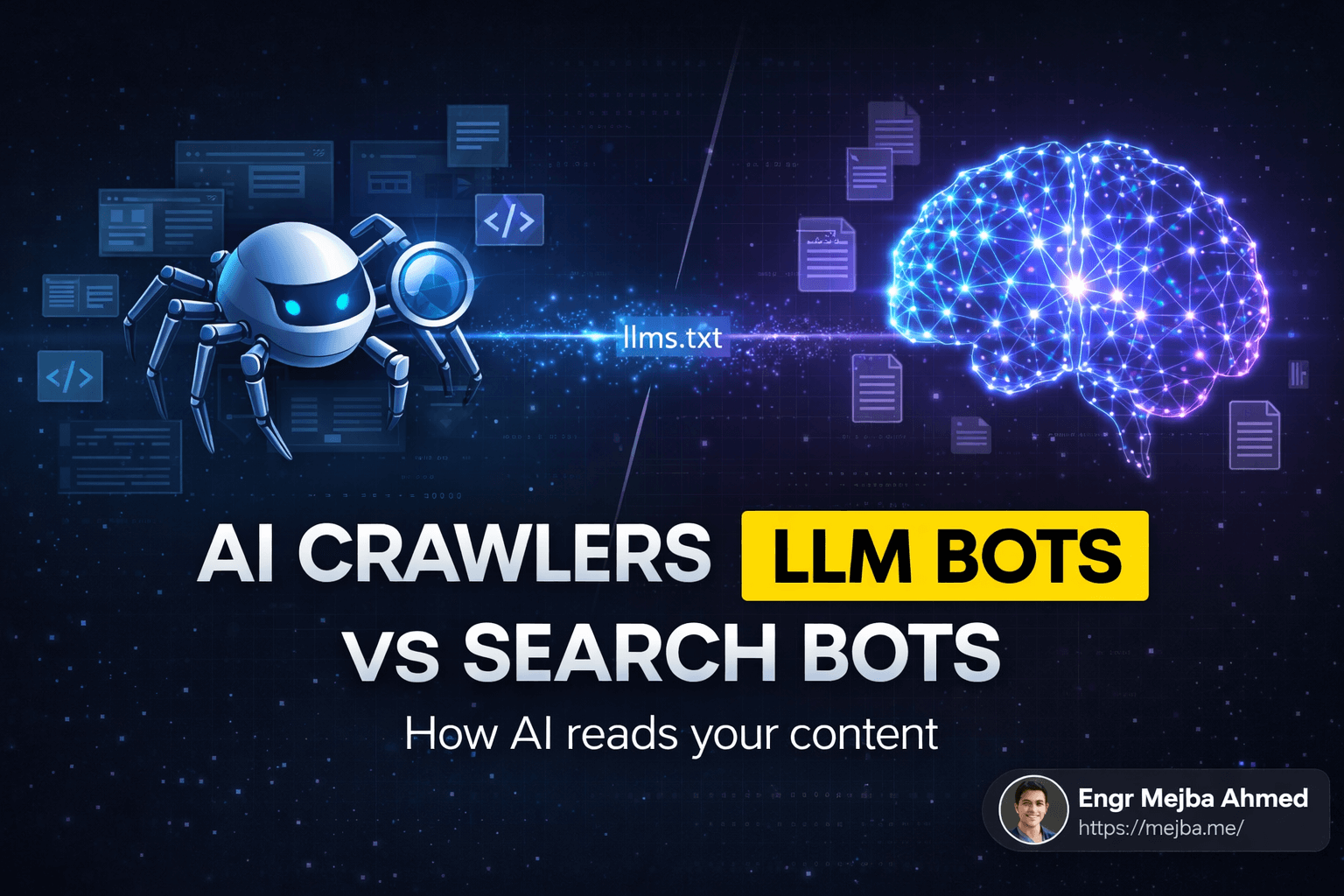
Understanding AI Crawlers: LLM Bots vs. Traditional Search Bots
Last month, I noticed something strange in my server logs. Alongside the familiar Googlebot and Bingbot entries, new user agents were showing up with increasing frequency: ClaudeBot, GPTBot, PerplexityBot. These weren't search engines indexing my content for their results pages. They were AI systems consuming my articles to answer questions, generate summaries, and power conversational interfaces.
I realized I'd been optimizing for the wrong audience. For years, I'd focused exclusively on making Google happy—strategic keywords, meta tags, backlink profiles. But a new category of digital readers had arrived, and they processed content fundamentally differently than traditional search crawlers.
This shift matters for anyone publishing content online. Understanding the difference between AI crawlers and traditional search bots isn't just technical curiosity—it's increasingly essential for visibility in how people actually find and consume information.
What Are AI Crawlers, and Why Should You Care?
AI crawlers are automated systems that navigate the web to gather training data, update knowledge bases, and fetch real-time information for AI assistants. Unlike traditional search bots that simply index content, AI crawlers attempt to understand and interpret what they're reading.
When Googlebot visits your page, it extracts keywords, analyzes link structures, and stores data for retrieval when someone searches for matching terms. The bot doesn't "understand" your content in any meaningful sense—it maps relationships between text patterns and query intents.
When an AI crawler like ClaudeBot or GPTBot visits the same page, the goal is different. These systems extract content to train language models, update retrieval systems, or provide context for answering user questions. The crawler isn't just cataloging your page—it's potentially learning from it, incorporating your explanations into how it responds to future queries.
This distinction has practical implications. A page that ranks well on Google might be invisible to AI systems if the content structure doesn't translate well to language model comprehension. Conversely, well-organized, clearly written content might get excellent AI representation even without strong traditional SEO signals.
The Technical Differences That Matter
Traditional search bots and AI crawlers approach the web with fundamentally different architectures.
Crawl frequency and depth. Googlebot maintains an extensive crawl schedule optimized for freshness and importance. High-authority sites get crawled constantly; smaller sites might wait weeks between visits. AI crawlers often prioritize breadth over depth—they want diverse perspectives rather than exhaustive indexing of any single domain.
Content processing. Search bots tokenize content into indexable units, weighting terms by position, density, and surrounding context. AI crawlers often consume entire documents as training examples or retrieval chunks. They care about how ideas flow, how concepts connect, and whether explanations are self-contained.
Link handling. Traditional search engines treat links as votes of confidence—more inbound links from authoritative sources improve rankings. AI systems generally care less about link graphs and more about content quality. A blog post with zero backlinks but excellent explanations might train a language model just as effectively as a heavily-linked Wikipedia article.
Semantic understanding. This is the crucial difference. Search bots match keywords; AI crawlers attempt to understand meaning. When someone asks an AI assistant about a topic, the system doesn't just retrieve pages containing those keywords—it tries to understand the question and find content that genuinely answers it.
LLM Bots: The New Information Gatekeepers
Large Language Model bots represent a specific subset of AI crawlers. These are systems like GPTBot (OpenAI), ClaudeBot (Anthropic), and PerplexityBot that gather content specifically for training or augmenting conversational AI systems.
When you ask ChatGPT a question, the response might incorporate information that GPTBot gathered from your website during training. When you use Perplexity for research, PerplexityBot may fetch and synthesize your content in real-time. Your published writing becomes source material for AI-generated answers.
This creates interesting dynamics:
Attribution becomes complicated. Unlike a Google search result that links directly to your page, an AI-generated answer might incorporate your insights without clear sourcing. Some systems like Perplexity include citations; others blend sources invisibly.
Quality signals differ. Traditional SEO rewards optimization tactics—keyword density, backlinks, page speed. LLM systems reward clarity, accuracy, and comprehensive coverage. An AI trying to understand a concept benefits from thorough explanations, not keyword stuffing.
User interaction changes. People increasingly get answers from AI assistants rather than visiting source websites. Your content might inform thousands of AI responses without generating a single click to your site. This shifts the value proposition of web publishing in ways we're still figuring out.
Traditional Search Bots: Still Essential, Just Not Alone
Despite the rise of AI crawlers, traditional search bots remain critically important. Google still drives the majority of web traffic, and proper search engine optimization remains foundational for online visibility.
Traditional search bot behavior is well-documented and predictable:
Crawl budget allocation. Search engines allocate finite crawling resources based on site authority, update frequency, and content quality. High-value pages get crawled more frequently.
Indexing decisions. Not everything crawled gets indexed. Bots evaluate content quality, duplication, and relevance before deciding whether to include pages in search results.
Ranking factors. Page speed, mobile responsiveness, backlink profiles, content freshness, and hundreds of other signals influence where pages appear in search results.
The difference from AI crawlers is that search bots don't need to "understand" your content—they need to categorize it accurately so humans can find it through keyword searches. This distinction matters for how you structure and optimize your pages.
A Dual-Optimization Strategy That Actually Works
Given these different systems, how do you create content that works for both audiences? Through experimentation on my own sites, I've developed a framework that improves visibility across both traditional search and AI systems.
Write for humans first, then structure for machines. Clear, comprehensive explanations benefit both AI comprehension and user experience. Start with genuinely useful content, then add technical optimization.
Use explicit structure. Headers, subheaders, and logical organization help both search bots and AI crawlers parse your content. When concepts build on each other, make that progression obvious.
Implement schema markup generously. Structured data helps search engines understand your content type and relationships. This same structured information often improves how AI systems interpret your pages.
Create self-contained explanations. AI systems often extract chunks of content for retrieval. If each section of your article makes sense independently, you're more likely to get accurate AI representation.
Maintain factual accuracy. AI systems increasingly cross-reference information across sources. Factual errors might get filtered out, while consistent accurate information reinforces your content's value.
Update regularly. Both search engines and AI crawlers favor fresh content. Regular updates signal ongoing relevance and trigger more frequent crawling.
The llms.txt Standard: Communicating With AI Crawlers
A fascinating development in this space is the emergence of llms.txt, a proposed standard for communicating with AI crawlers similar to how robots.txt communicates with search bots.
The llms.txt file sits in your site's root directory and provides AI systems with essential context about your website. It typically includes a brief description of your site, key pages AI systems should prioritize, and optional guidelines for how your content should be represented.
Here's what this looks like in practice: you create a markdown file at yoursite.com/llms.txt that introduces your site, lists important resources, and provides context that helps AI systems understand your content's purpose and authority.
This is still an emerging standard, but major AI companies are increasingly recognizing and respecting these files. If you want AI systems to accurately understand and represent your content, implementing llms.txt is worth considering. You can learn more about the specification and best practices at llmstxt.org.
Practical Implementation Steps
If you want to optimize for both traditional search and AI discovery, here's a concrete action plan:
Audit your current visibility. Check how your content appears in both Google search results and AI assistant responses. Ask ChatGPT, Claude, and Perplexity about topics you've written about. See if and how they represent your information.
Review your robots.txt. Decide whether you want AI crawlers accessing your content. Some sites block GPTBot or ClaudeBot; others welcome them. Make a conscious choice based on your goals.
Create an llms.txt file. Even a basic implementation helps AI systems understand your site's purpose and key content. This is low effort with potential high impact.
Improve content structure. Add clear headers, use consistent formatting, and ensure each section provides value independently. Both search bots and AI crawlers benefit from logical organization.
Implement comprehensive schema markup. Use JSON-LD to describe your content type, authorship, publication date, and relationships. This structured data improves comprehension for all automated systems.
Monitor and iterate. Track how your visibility changes across both search rankings and AI representations. This is new territory, and what works best may evolve as AI systems mature.
The Bigger Picture: Information Discovery Is Fragmenting
What we're witnessing is a fundamental shift in how people find information. For two decades, Google dominated discovery—you optimized for search rankings because that's where traffic came from.
Now discovery is fragmenting. Some people still search Google. Others ask AI assistants. Many use specialized tools like Perplexity that blend search and AI. Social platforms drive discovery. RSS is experiencing a renaissance among certain audiences.
This fragmentation doesn't mean traditional SEO becomes irrelevant—it means SEO becomes necessary but not sufficient. Creating content that only satisfies Google's ranking algorithm increasingly misses audiences who discover information through other channels.
The publishers who thrive in this environment will be those who create genuinely valuable content that works across discovery mechanisms. That means writing clearly, structuring logically, maintaining accuracy, and making it easy for both human readers and automated systems to extract value from your work.
The good news: what's good for AI crawlers is largely what's good for human readers. Clear explanations, logical structure, and factual accuracy improve the experience for everyone. The technical optimizations matter, but they're secondary to creating content worth consuming in the first place.
Start by making your content excellent. Then ensure both traditional search bots and AI crawlers can find and understand it. That dual strategy is the new baseline for online visibility.
Let's Work Together
Looking to build AI systems, automate workflows, or scale your tech infrastructure? I'd love to help.
- Fiverr (custom builds & integrations): fiverr.com/s/EgxYmWD
- Portfolio: mejba.me
- Ramlit Limited (enterprise solutions): ramlit.com
- ColorPark (design & branding): colorpark.io
- xCyberSecurity (security services): xcybersecurity.io
