
Structured ChatGPT-5 Prompt Engineering: The Complete Guide to Faster, Higher-Quality Outputs
Introduction
The leap from GPT-4 to ChatGPT-5 isn’t only about improved intelligence—it’s about structured prompting. Engineers, prompt designers, and product teams building agentic workflows quickly realize that how you prompt GPT-5 determines both speed and quality.
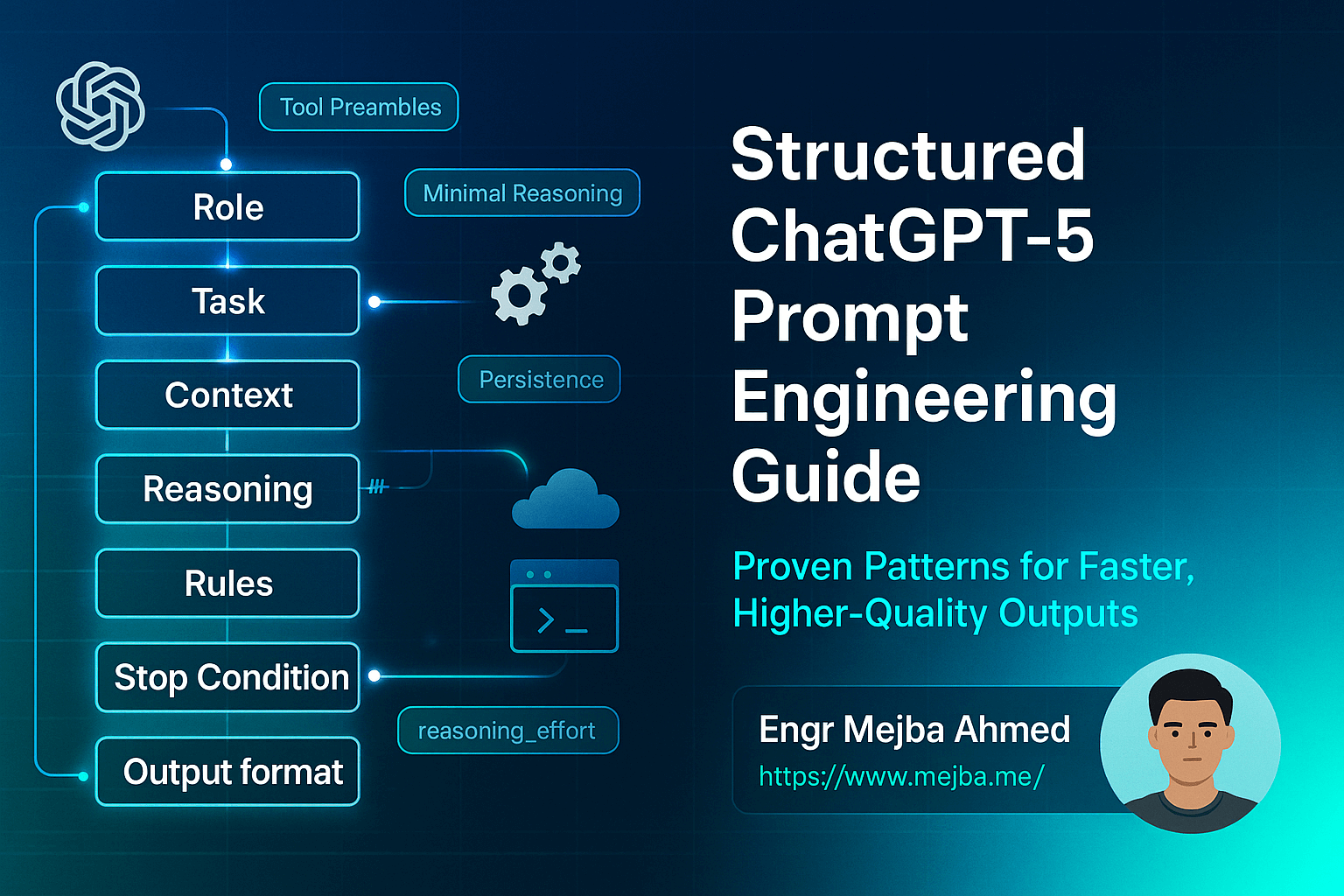
This structured ChatGPT-5 prompt engineering guide breaks down actionable patterns like minimal reasoning, persistence in agents, tool preambles, and reasoning_effort. We’ll also explore the Responses API, prompt optimizers, and a copy-pasteable Prompt Step Framework you can apply today.
By the end, you’ll have a clear prompting toolkit to unlock faster, more reliable workflows.
Why Structured Prompting Matters in GPT-5
With GPT-5, the difference between a vague prompt and a structured one is dramatic:
- Poor prompts → latency, tool misuse, and inconsistent outputs.
- Structured prompts → predictable, fast, high-quality outputs.
Structured prompt engineering enables:
- Scalability in team workflows.
- Consistency across API calls.
- Efficiency by balancing minimal reasoning with reasoning_effort.
Core Prompting Patterns in ChatGPT-5
1. Minimal Reasoning
- Use when tasks don’t require deep analysis.
- Speeds up execution and reduces costs.
- Example: Instead of “Explain your approach to sorting this JSON,” → “Sort this JSON alphabetically by keys. Output only JSON.”
2. Persistence in Agents
- Helps agents maintain context across steps.
- Store compact state (e.g., “User prefers Python outputs”) and pass it forward.
- Boosts workflow reliability.
3. Tool Preambles
-
Tools perform best with a consistent preamble.
-
Example:
You are a calculator. Input: [expression] Output: numeric result only. -
Reduces tool misuse and stabilizes outputs.
4. reasoning_effort
- A GPT-5 control parameter.
- Low effort → faster, shallow outputs.
- High effort → slower, more detailed reasoning.
- Best practice: Match effort level to task complexity.
Designing Agentic Workflows with GPT-5
Role of the Responses API
The Responses API enables structured multi-step execution. Combined with persistence and tool preambles, it builds agentic workflows that scale.
Using a Prompt Optimizer
Teams can A/B test prompts with a prompt optimizer to measure latency vs. quality. This ensures you always use the best-performing version.
Multi-Step Structuring
Plan workflows as Plan → Execute → Notes or with the more robust Prompt Step Framework below.
The Prompt Step Framework (Copy-Paste Template)
Here’s a structured GPT-5 prompting guide you can use right away:
# Structured ChatGPT-5 Prompt Engineering Framework

## Role
Define the AI’s role clearly.
Example: "You are an AI software engineering assistant."

## Task
Specify the exact task.
Example: "Refactor the given Python code for efficiency."

## Context
Provide necessary context or constraints.
Example: "The code must run on Python 3.10 and avoid external libraries."

## Reasoning
Set the level of reasoning required.
Example: "Apply minimal reasoning. Only explain if optimization is non-obvious."

## Rules
List rules to follow.
Example:
- Stick to Python 3.10
- Avoid third-party imports
- Keep comments concise

## Stop Conditions
Define when to stop.
Example: "Stop after producing the optimized code snippet."

## Output Format
Specify formatting.
Example: "Output code only in a fenced code block."
This framework aligns with structured prompt design, improving clarity and reproducibility.
Avoiding Common Pitfalls in GPT-5 Prompting
- ❌ Over-explaining tasks → slows down responses.
- ❌ No persistence → agents lose context.
- ❌ Vague tool usage → misinterpretation and errors.
Advanced Patterns for Product Teams
- Shared [Prompt Library]: Standardize prompts across workflows.
- Monitoring with [AI Dashboard]: Track latency, accuracy, and failures.
- Agent Scaling: Use structured templates to expand to multiple use cases.
FAQs
Q1: What makes structured prompting different from normal prompting? It enforces clarity with steps like Role, Task, and Output Format, reducing ambiguity.
Q2: How do I balance reasoning_effort? Use low effort for simple tasks, high effort for planning or critical decisions.
Q3: Why is persistence in agents important? It ensures context continuity, so agents don’t “forget” state across steps.
Q4: Can I combine tool preambles with persistence? Yes—together they reduce error rates and increase consistency.
Q5: What’s the fastest way to optimize my prompts? Run variations through a prompt optimizer and measure outcomes in [AI Dashboard].
Key Takeaways
- Structured prompting reduces latency and improves quality.
- Minimal reasoning prevents unnecessary delays.
- Persistence makes agents more reliable.
- Tool preambles and reasoning_effort are critical for precision.
- Prompt optimizers + Responses API = scalable agentic workflows.
Conclusion + CTA
The future of ChatGPT-5 prompt engineering is structured. By applying minimal reasoning, persistence, tool preambles, and reasoning_effort, you unlock faster, higher-quality agentic workflows.
👉 If you’re looking for expert help with AI, prompt engineering, or building agentic workflows, I offer professional services to bring your ideas to life.
🔗 Hire Me on Fiverr: AI Prompt Engineering & Automation Services
🔗 References
- OpenAI Documentation: GPT-5 Prompting Guide
- Anthropic Research